Donnie Darko: Why 1988?
- Smurfs
- Dukakis vs. Bush (see the Living Room Candidate)
Donnie Darko: Why 1988?
Ada mentioned how videogames are being used by the U.S. military to recruit and train soldiers–the flipside of the machinima phenomenon. A while ago on my own blog I wrote about this very same issue: videogames and war.
Among the games I mention is America’s Army, the Official U.S. Army videogame. Download now and let yourself be interpellated as a hard-core killing machine!
If you’ve read the wikipedia article on machinima and you are still confused, check out Clive Thompson’s article for the New York Times Magazine about the most popular machinima, "Red Vs. Blue," created from the successful Xbox game Halo.
If you don’t want to register for the New York Times online (trying to avoid the super-panopticon, are you?), you can also read the original article on Clive Thompson’s blog, Collision Detection.
Key links for the discussion on American Postmodernism and technology:
Databases as Discourse
Digital Textuality
You can find online the short Borges fable that Baudrillard writes about: "On Exactitude in Science".
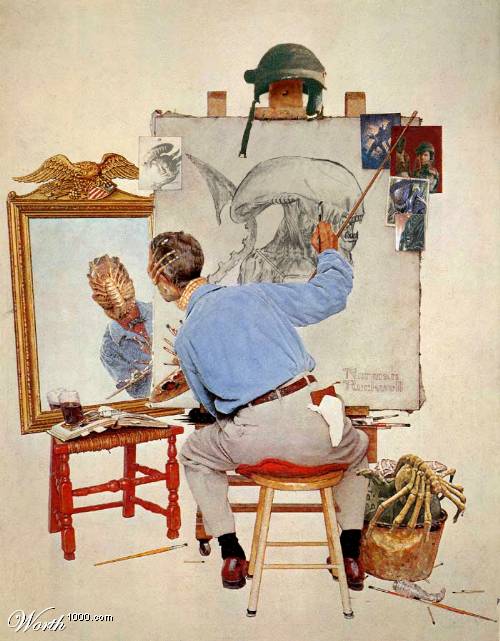
Apropos of both Halloween and last week’s discussion on photography, simulacra, and Photoshop, check out Worth1000.com, a site that holds photoshopping contests. The latest contest challenges graphic artists to mashup a classic work of art with a monster (usually a Hollywood version of a monster).
So, we get things like Norman Rockwell meets Alien and Monet meets Swamp Thing.
As you work your way through Jessica Hagedorn’s Dream Jungle, you might want to read up on Philippine history, both ancient and contemporary. The novel is deeply invested in history, but also deeply playful, and, like Song of Solomon, deeply intertextual as well. The more of these historical and textual allusions you pick up on, the better appreciation you’ll have for the subtleties of the novel.
Just a sampling to consider: the Lopez de Legazpi name, the discovery of the Tasaday Tribe, Jose Rizal, Antonio Pigafetta and his account of the Magellan expedition, Hollywood Hills, Goya’s The Great He-Goat and Saturn Devouring His Son, the film Apocalypse Now.
See also David Lodge’s interview with Jessica Hagedorn.
Wow! I believed I had read feminist literature before, but nothing ever came close to The Female Man in absolutely crushing down on males and the nature of men’s interaction with females!
Reading Donna Haraway’s “A Cyborg Manifesto” alongside TheFemale Man, I find that the latter also reads a bit like a manifesto. When the fourth ‘I’, Alice-Jael, which has been lurking behind the text since Part Two finally emerges, it becomes evident that she is the one who has actively searched for and brought together the three other versions of ‘herself’. Her reason for doing so is to make the other versions of herself aware of what is to her the Ultimate War, and to which purpose they should attempt to unite their efforts.
The text’s gathering of the different selves is explanatory both to the women characters and to the readers, as it reveals how different circumstances and attitudes towards life have shaped these genotypically analogous women. It exposes the extent to which male domination over women has been, are, and will remain constant if not challenged, as well as the rhetoric on which this power structure rests. Together these insights reveal to Jeannine, the ultimate frustrated feminine, the manipulative constructedness of the dream of romantic fulfillment through marriage. To Joanne they confirm her conviction that the only way for her to fully utilize her human potential is to become a ‘female man’. Because being a woman implies being not human, noting that is feminine defines her. As Julie pointed out in her blog, Janet represents a world in which women hold real power and influential positions in society. Inhabited by women only, Whileaway is a world without gender and gender conflict. The female god the inhabitants worship is not a unity, but a “jumble of badly matching planes, a mass of inhuman contradiction” (103). Hence Janet represents the Harawayan cyborg, and the ‘future’ world of Whileaway one in which the new notion of feminitity as partial and contradictory is fully developed. Interestingly, the Whileawayan genderless society is so peaceful and satisfying to its inhabitants that Janet is the only ‘self’ unwilling to join Jael’s mission.
Jael herself is the warrior turned hateful heartless and pitiless as a result of men’s violations. She has lost her outward human shape and become a murderer justified in the fact that as a woman (raped), she is always already guilty. (In fact, she rather resembles Janet’s image of self-hate.) Like her biblical namesake’s, Jael’s violence against men acts to liberate her ‘people’ from suppression. She works to defeat all men, and in her home man is the submissive object of desire that exists merely to provide pleasure. In what I thought was a very funny and significant passage, the rhetoric of gendered language is reversed to describe David as a creature of beauty with a consciousness void of everything “but the permanent possibility of sensation” (199).
Jael has gathered her other selves to awaken them to her call for action. She urges them to unite across the differences that separate them to fight for the liberation of womankind. Like the reader must try to unite all the shattered fragments of the text into an understanding of how its plot works, so women situated at all the different nodes in the network that constitutes feminine experience should try to unite in an understanding of what battles must be fought in order to do away with the limitations on the female experience: the social constructs that separate the female from the human. Because the author’s name is Joanna Russ, this makes it possible to read Joanna’s (the character’s) voice as the voice of the author. One of the ‘I’s whose consciousness pervades the text is also expressed to be the “the spirit of the author” in the process of constructing this deliberately feminist text, which she upon completion will let into the world to influence its readers (166). Through these two narrative techniques the text asserts itself, despite its wildly imaginative plot, as part of a real contemporary feminist discourse. The Female Man is thus a manifesto in the sense that it declares an ultimate goal for which women should apply themselves, and inscribes the text itself as vital agent in achieving this end.
And with that highly intelligent title, I think I have summed up my reaction to both the novel and the article. while I have often found dense texts in the courses I have been in challenging, rarely have I been so stymied by the complex situations and ideas presented by these two authors. Part of the reason for this in Russ’ text is the sheer lack of anyone with whom I can relate any sentiment. Not only is the story a scream for feminism and a call to rethink ideas of gender roles, but it is so lopsided in its representations and characters that I feel completely blank when trying to assimilate the text into any kind of association with my life.
Here’s a replay of the Nietzsche passages on the nature of truth, all taken from "On Truth and Lying in an Extra-Moral Sense" (1873):
The arrogance associated with knowledge and sensation lays a blinding fog over man’s eyes and senses and deceives him about the value of existence by instilling in him a most flattering estimation of this faculty of knowledge….
What is truth? A mobile army of metaphors, metonyms, anthropomorphisms….
Truths are illusions about which it has been forgotten that they are illusions….
If someone hides an object behind a bush, then seeks and finds it there, that seeking and finding is not very laudable: but that is the way it is with the seeking and finding of "truth" within the rational sphere….
Lenny makes a point while arguing with his wife that the point of reading a book is to find out what happens in the end; that is where the enjoyment of reading is based in Lenny’s world. In a way I think this is Nolan making a little funny about his film. If anything, we, as viewers, already know what has happened. The ending is the first thing we see. But I don’t think the plot of the film is based around the actions of our memory deficient friend. While the noir aspect of the film places much of the emphasis on the detective efforts, memory (history, if you want to link this up to Harvey’s ideas) is what this film focuses on. Why else do all the explanations Lenny gives in the black and white moments focus on how he has disciplined his memory and how others (like Sammy Jankis) are weak. While Lenny has convinced himself that he cannot form new memories, the fact that he has been able to form so many new habits proves otherwise. His memory is fine. The ritual of tattooing is one he can perform almost in passing and while talking on the phone. Taking pictures of people and things is an instinctive reflex almost. Writing his notes is an almost religious experience (while he can remember to do it in time). Most important in this idea of memory is the moment when he decides to make Teddy the focus of his revenge. From the moment of that conscious decision, if you watch the film backwards, Teddy has become the focal point of his memory. Harvey says in his article that "And if it is true that time is always memorialized not as flow, but as memories of experienced places and spaces, then history must indeed give way to poetry, time to space, as the fundamental material of social expression" (Harvey pg 218). Lenny has conditioned himself to recognizing spaces and phrases of power (poetry in his tattoos). In the internal monologues, the unfamiliar hotel room is a routine that he goes through to help him remember. the simple action of opening drawers despite a precognition of "knowing" nothing would be in them is one of Lenny’s conditioned memory triggers. he knows what’s coming even though he tells himself he doesn’t. While his notion of time has disappeared completely, where he is, and what he can see is his history.
I like the talking heads 
Fear has always been a factor in most of my decisions. As a family man, I often have to act out of fear of how the outcome will affect them. Yet Orr seems to operate outside of this impulse. The idea that he is dead in the middle of all things seems to imply that his motivation really does seem to fall in the range of affecting the most people in a positive way. Can you imagine a political candidate who appeals to both sides equally? While talking to Orr, Haber mentions that the governing power of fear is a Victorian notion that destroyed the best minds of the nineteenth and twentieth century; that the end result of what he and Orr were doing was to eradicate fear.
But Orr response to the idea of having nothing to fear was, “But there is…”.
The different responses to fear illustrate their different perspectives. When confronted with the greatest moments of fear, Orr’s reaction was one that benefited humanity, even if it were often in miniscule ways. But as an extreme example, when faced with the end of the world (the burning world), he saved humanity while still making the world normal; fearful.
Haber’s idea was to eradicate fear, to change the world into a perfect utopia. Anyone who has ever seen a movie with a genie in it, knows that if you wish for a perfect world, it doesn’t happen. Yet for al his supposed good intentions, Haber’s world s governed by fear as well. When the alien’s were “attacking” his reaction was not to protect Orr, or even humanity, but to throw himself over the Augmentor.
Orr dealt with life as it happened, and towards the end of the book, seemed to realize the inevitability of actions. Orr operated based on his fear; not knowing the outcome. When Haber almost destroyed reality, what drove Orr to succeed was the fear of losing Heather and his chaotic life.
Harvey mentions this idea in his essay when he says, “The boundary between fiction and science-fiction has, as a consequence, effectively dissolved, while postmodernist characters often seem confused as to which world they are in, and how they should act with respect to it. Go with the flow; don’t worry, be happy; cool runnings. Like an abstract or minimalist painting, what is on the outside is not important. Everyone underestimated Orr because on the outside he appeared weak, yet no one ever took the time to delve into the depths of his mind and actions. While he often reacted out of fear, even if it was to take dugs out of fear of hurting others, his actions eventually led to a greater good, even if it were an imperfect world.