

A) Uploaded March 24, 2006 by Stuart_aka_stu_macgoo
“I opened the microwave, and the bottom of it was filled with rancid grease. Alex had been using it to cook chicken, and it never occurred to him that the grease had to drain somewhere. It wasn’t that he was too lazy to clean it up – Alex always kept things real neat and orderly – it was just that he hadn’t noticed the grease.†– Wayne Westerberg (63)
This is a photograph of a man with a surprised expression on his face as he looks into a microwave. I had found other images that actually displayed grease in the bottom of a microwave, but I thought it would be more interesting to focus on what Westerberg’s face might have looked like when he found the mess. I feel that this is an important scene to portray because it exhibit’s Alex’s lack of common sense. Westerberg’s astonishment that Alex – whom he thought of as hard working, clean, and intelligent – could be clumsy enough to not notice grease, solidifies the notion that Alex definitely had shortcomings.
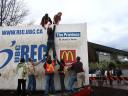

B) Uploaded April 2, 2006 by Engineered Photography
“I though he’d be fine in the end. He was smart. He’d figured out how to paddle a canoe down to Mexico, how to hop freight trains, how to score a bed at inner-city missions. He figured all of that out on his own, and I felt sure he’d figure out Alaska too.†– Jan Burres (46)
This picture shows a woman being helped over a wall that is covered in advertisements in front of an empty canoe. I selected this image because the canoe and the wall with the names of corporations on it intrigued me. The caption lists many of the things that Alex did on his own as part of his adventure and rejection of societal superficialities. There is a rich amount of irony in the juxtaposition of this image and Jan Burres’ quote. The picture can be used to represent a rejection of commercial/capital life as it depicts a person climbing over a wall or obstacle adorned with commercial advertisements, which parallels Alex’s adventure and resentment. There is a definite dissonance between the image and text: Alex was insistent that he accomplish his adventure alone, the woman in the picture is receiving help from several people. Furthermore, Alex was set on using his canoe to find an opening to the ocean as part of his “mission,†the woman in the photograph has, ostensibly, abandoned her canoe and gotten help from people who are diverse enough that they could be a cross sectional representation of society. The message of this photo in alignment with this caption might be that Alex may have had more luck working with society than against it.

C) Uploaded on March 31, 2006 by scienceduck
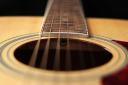
“Walt bought Billie a Gianni guitar, on which she strummed lullabies to soothe the fuzzy newborn. Twenty-two years later, rangers from the National Park Service would find that same guitar on the backseat of a yellow Datsun abandoned near the shore of Lake Mead†(106).
This is an image of the front of an acoustic guitar on a black background. I chose this picture because the guitar is a tangible and personal item that McCandless has had since birth and takes with him on his adventure. It connects his “normal†life, before he resented society and his family, to his outlandish journey. Obviously, Flickr has an astronomical amount of guitar pictures; I chose this one because it has a nebulous background, much like the life of McCandless’ guitar seemed to follow an uncertain path, as described in the caption. Additionally, the guitar is important because – more so than the guitar – it represents McCandless’ rejection of his former self: it is something he has had throughout his life, as Chris, but leaves in the Datsun as he becomes Alex.

D) Uploaded January 6, 2006 by xinmincat
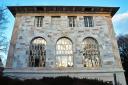
“…But he had been smitten by the vastness of the land, by the ghostly hue of glaciers, by the pellucid subarctic sky. There was never any question that he would return. During his senior year at Emory, Chris lived off campus in his bare, spartan room furnished with milk crates and a mattress on the floor†(124).
This is a photo of an opulent marble building at Emory University whose windows reflect the beginning of a forest under a vast blue sky. This is by far my favorite of the images that I found for this assignment. The caption discusses McCandless’ return to Emory after road tripping to Alaska the previous summer. It seems that even while at Emory, Chris was anxious to go into the wild and even began living a solitary and somewhat dismal life while still at college. The image is inherently ironic: it depicts a decadent building at Emory, which Chris felt resentment toward, but the windows reflect trees and wilderness, which he longed for. There is also the obvious irony that Chris was living in a room “furnished with milk crates†while attending classes at this prestigious university.
Synthesis)
An applicable (or even seemingly inapplicable) photograph can have a profound meaning on captions from, and the totality of, Into the Wild. While searching for images, many times I had in mind exactly what I wanted the pictures to look like, but during the search found photos that opened the text in ways I had not seen before. An example of this is the photo of Emory University that I used. I had intended to simply find a picture of Emory and discuss the contrast between the lavish college McCandless attended and the rugged journey he chose to take. However, when I found the picture of the building reflecting trees, I began to analyze and try to empathize with Alex’s experience at Emory his senior year and how he dealt with the desire to head north.
A photograph and caption definitely have a mutually causal relationship. When I was browsing photos, I tried to ignore given captions, knowing that they would probably hinder my ability to apply them to parts of Into the Wild. Likewise, after assigning my chosen photos captions, it is hard to see them in any other light besides corresponding to parts of McCandless’ life. This is particularly true of the photo I used to describe when Alex left grease in the microwave. The man’s face in the pictures could be in response to anything, however, I have designated it as definitely being Westerberg upon seeing Alex’s mess. Conversely, this influences the way I see Westerberg’s appearance and immediate reaction, which was not vividly described by Krakauer.
Because of the breadth of Into the Wild, it is very easy to quote it out of context. At the same time, however, many elements of story seem to be asserted, as they are, out of context. This presents an interesting paradox that leads me to believe that, within reason, it is healthy to explore a variety of meanings for much of the story’s content.
I truly enjoyed the use of hummer in the first picture and caption but as i went through i was taken in. Particularly by the picture of the person being pulled over the wall and the one of the building from Emory. The one with the wall I would have never put those analogies together and they really make me think I particularly like the reference to the advertisements and the connection to them and Chris’ distaste for the commercial world another connection I noticed was the Mcdonadls add where he ironically worked for a while during his journey. But the last picture was truly amassing choice the image is perfect and explains his quote quite well it also leaves lots of room for comparison to the text and Chris him self. All of the images I feel were very effectively chosen and described in the passages.